
Analytic Geometry bridges algebra and geometry, utilizing algebraic equations to represent geometric shapes; numerous pdf resources detail this crucial mathematical branch;
Historical Development of Analytic Geometry
The seeds of Analytic Geometry were sown in the 17th century, with pivotal contributions from both René Descartes and Pierre de Fermat. Descartes, in an appendix to his 1637 work, provided the initial description, laying the groundwork for connecting algebraic equations with geometric forms. This breakthrough enabled geometric problems to be solved algebraically, and vice versa.
Prior to this, geometry was largely a qualitative field. The introduction of a coordinate system allowed for quantitative analysis. Numerous pdf resources now document this evolution, tracing how Descartes’ ideas, alongside Fermat’s independent developments, revolutionized mathematical thought. This fusion spurred advancements across physics and engineering, solidifying its importance.
René Descartes and Pierre de Fermat’s Contributions
Both René Descartes (1596-1650) and Pierre de Fermat independently developed the foundations of Analytic Geometry. Descartes, credited with popularizing the field, introduced the Cartesian coordinate system – a framework for mapping points using algebraic coordinates. His 1637 publication detailed this approach, linking algebra and geometry.
Fermat, concurrently, also explored similar concepts, though his work wasn’t as widely disseminated initially. Both mathematicians enabled the representation of geometric shapes as algebraic equations. Modern pdf textbooks highlight their parallel discoveries, emphasizing how this connection allowed for the analysis of geometric problems using algebraic techniques. Their combined efforts fundamentally reshaped mathematical methodology.
The Relationship Between Algebra and Geometry
Analytic Geometry establishes a profound connection between algebra and geometry, allowing geometric shapes to be represented by algebraic equations and vice versa. This interplay enables the solution of geometric problems through algebraic manipulation, and conversely, the visualization of algebraic relationships geometrically.
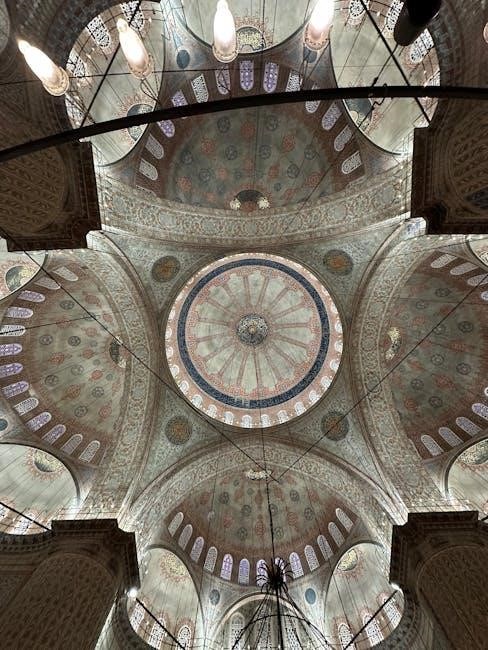
This relationship is central to understanding curves and surfaces. A pdf study guide will demonstrate how equations define lines, circles, parabolas, and more. This bridge isn’t merely representational; it’s functional, allowing for precise calculations of distances, areas, and other geometric properties using algebraic formulas. This synergy revolutionized mathematical problem-solving, offering a powerful new toolkit for analysis.

Coordinate Systems and Lines
Analytic Geometry utilizes coordinate systems—like the Cartesian plane—to define points and lines algebraically; pdf resources illustrate these foundational concepts clearly.
The Cartesian Coordinate System
The Cartesian coordinate system, fundamental to analytic geometry, provides a framework for representing geometric shapes algebraically. This system, utilizing perpendicular axes – typically labeled ‘x’ and ‘y’ – allows any point to be uniquely identified by an ordered pair (x, y). Numerous pdf resources delve into its intricacies.
This system’s power lies in its ability to translate geometric problems into algebraic equations, and vice versa. Understanding the quadrants, the origin (0,0), and the relationship between coordinates is crucial. Many analytic geometry pdf textbooks begin with a thorough exploration of this system, emphasizing its role as the basis for all subsequent concepts. It’s the cornerstone for plotting points, lines, and curves, enabling precise mathematical analysis of geometric figures.
Distance Formula and Midpoint Formula
Within the Cartesian coordinate system, calculating distances and finding midpoints are essential operations in analytic geometry. The distance formula, derived from the Pythagorean theorem, determines the length of a line segment between two points (x₁, y₁) and (x₂, y₂): √((x₂ ⎯ x₁)² + (y₂ ⎯ y₁)²). Many analytic geometry pdf guides provide step-by-step examples.
The midpoint formula, conversely, finds the coordinates of the point exactly halfway between those same two points: ((x₁ + x₂)/2, (y₁ + y₂)/2). These formulas are foundational for solving geometric problems algebraically. Comprehensive pdf resources often include practice exercises to solidify understanding. Mastering these concepts unlocks the ability to analyze and manipulate geometric shapes with precision.
Slope of a Line and Equations of Lines
The slope of a line, a fundamental concept in analytic geometry, quantifies its steepness and direction. Calculated as (y₂ ⎯ y₁) / (x₂ ⎻ x₁), it reveals how much ‘y’ changes for every unit change in ‘x’. Numerous analytic geometry pdf tutorials explain this thoroughly. Understanding slope is crucial for determining if lines are parallel (equal slopes) or perpendicular (negative reciprocal slopes).
Line equations, often expressed in slope-intercept form (y = mx + b), directly relate slope (m) and y-intercept (b). Point-slope form (y ⎯ y₁ = m(x ⎻ x₁)) is useful when a point and slope are known. Detailed pdf study materials demonstrate how to convert between these forms and solve for unknowns, enabling graphical representation and algebraic manipulation of linear relationships.
Conic Sections: Circles
Circles, a key conic section, are defined by a constant distance from a center point; analytic geometry pdf resources detail their standard and general equations.
Definition and Standard Equation of a Circle
A circle is fundamentally defined as the set of all points equidistant from a central point. This constant distance is known as the radius. In the Cartesian coordinate system, this definition translates directly into an algebraic equation.
The standard equation of a circle with center (h, k) and radius r is expressed as: (x ⎯ h)² + (y ⎯ k)² = r². This equation elegantly captures the geometric properties of a circle within an algebraic framework.
Numerous analytic geometry pdf textbooks and online resources thoroughly explain this derivation and demonstrate its application in solving problems related to circles. Understanding this equation is crucial for analyzing and manipulating circular shapes mathematically. The radius ‘r’ must always be positive, representing a real distance.
General Equation of a Circle
While the standard equation provides clarity, a circle can also be represented by a more general form: x² + y² + 2gx + 2fy + c = 0. This form appears frequently in problem-solving and is derived through expansion of the standard equation.
Here, the center of the circle is (-g, -f), and the radius is calculated as √(g² + f² ⎻ c). A key condition for this equation to actually represent a circle is that g² + f² ⎻ c > 0; otherwise, it represents a point or has no real solution.
Many analytic geometry pdf materials demonstrate how to convert between the standard and general forms, a vital skill for tackling diverse circle-related problems. Mastering both forms provides a comprehensive understanding of circular geometry.
Tangents and Intersections of Circles
Determining the tangent to a circle involves finding a line that touches the circle at only one point. This often utilizes the circle’s equation and calculus principles, or geometric properties relating radius and tangent lines. Intersection points of two circles are found by simultaneously solving their equations – a core skill in analytic geometry.
These solutions can yield zero, one, or two intersection points, indicating the circles do not intersect, are tangent, or intersect at two distinct locations. Numerous analytic geometry pdf resources provide detailed examples and step-by-step solutions for these calculations.
Understanding these concepts is crucial for applications in various fields, including computer graphics and engineering.

Conic Sections: Ellipses
Ellipses, defined by two foci, possess unique properties detailed in analytic geometry. Many pdf guides illustrate their standard equations and geometric characteristics.
Definition and Standard Equation of an Ellipse
An ellipse represents the set of all points where the sum of the distances to two fixed points, called foci, remains constant. This fundamental definition, explored extensively in analytic geometry resources, leads to its characteristic equation. The standard equation of an ellipse centered at the origin varies based on its orientation.
For an ellipse with a horizontal major axis, the equation is x²/a² + y²/b² = 1, where ‘a’ is the semi-major axis and ‘b’ is the semi-minor axis. Conversely, if the major axis is vertical, the equation becomes x²/b² + y²/a² = 1. Numerous pdf textbooks and online materials provide detailed derivations and examples of these equations.
Understanding ‘a’ and ‘b’ is crucial; they dictate the ellipse’s size and shape. These parameters, alongside the location of the foci, are key components when analyzing and graphing ellipses using analytic geometry principles. Many pdf guides offer step-by-step instructions for determining these values.
Properties of Ellipses: Foci, Vertices, and Co-vertices
Ellipses possess unique properties defined by key points: foci, vertices, and co-vertices. The foci, central to the ellipse’s definition, determine the shape – a larger distance between them creates a flatter ellipse. Vertices are the endpoints of the major axis, representing the furthest points from the center. Co-vertices lie on the minor axis, marking the closest points.
These points are mathematically linked. The distance from the center to each focus is denoted as ‘c’, related to ‘a’ and ‘b’ by the equation c² = a² ⎯ b². Analytic geometry pdf resources thoroughly explain these relationships and provide methods for calculating these values given the ellipse’s equation.
Understanding these properties is vital for sketching ellipses and solving related problems. Many pdf textbooks offer practice exercises to solidify comprehension of these fundamental characteristics, enabling students to confidently analyze and manipulate elliptical equations.
Applications of Ellipses

Ellipses aren’t merely abstract geometric shapes; they appear frequently in real-world applications. A prime example is planetary orbits – planets travel around stars in elliptical paths, with the star at one focus. This is described by Kepler’s Laws of Planetary Motion, a cornerstone of astronomy.
Furthermore, ellipses are crucial in architectural design, particularly in creating aesthetically pleasing arches and domes. Sound reflection within elliptical rooms focuses sound waves to specific points, enhancing acoustics. Analytic geometry pdf materials often showcase these practical uses.
Engineering also utilizes elliptical shapes in designing reflectors for light and radio waves. Many pdf study guides demonstrate how to model these applications using elliptical equations, providing practical problem-solving skills and illustrating the power of mathematical modeling.

Conic Sections: Parabolas
Parabolas, defined by a focus and directrix, are essential conic sections; analytic geometry pdf resources detail their unique properties and standard equation forms.
Definition and Standard Equation of a Parabola
A parabola represents the set of all points equidistant to a fixed point (the focus) and a fixed line (the directrix). This fundamental definition, thoroughly explored in analytic geometry pdf materials, leads to its characteristic equation. The standard equation varies based on the parabola’s orientation.
For a parabola opening upwards or downwards, the equation is (x-h)² = 4p(y-k), where (h,k) is the vertex and ‘p’ is the distance from the vertex to the focus and from the vertex to the directrix. If ‘p’ is positive, it opens upwards; negative, downwards.
Conversely, for parabolas opening left or right, the equation becomes (y-k)² = 4p(x-h). A positive ‘p’ indicates opening to the right, while a negative ‘p’ signifies opening to the left. These standard forms, readily available in analytic geometry pdf guides, are crucial for analysis.
Properties of Parabolas: Focus, Directrix, and Vertex
Understanding the focus, directrix, and vertex is central to grasping parabolic properties, as detailed in comprehensive analytic geometry pdf resources. The vertex is the turning point of the parabola, lying midway between the focus and the directrix. The focus is a fixed point defining the curve, while the directrix is a fixed line.
The distance from any point on the parabola to the focus equals its distance to the directrix. This defining characteristic is consistently illustrated within analytic geometry pdf tutorials. The parameter ‘p’ in the standard equation represents this distance.

Determining these elements allows for accurate sketching and analysis of parabolas. Analytic geometry pdf materials often provide step-by-step methods for locating these key features from a given equation.
Applications of Parabolas
Parabolas exhibit diverse real-world applications, thoroughly explored in analytic geometry pdf study guides. Their reflective property makes them ideal for satellite dishes and headlights, focusing incoming signals or light to a single point – the focus. This principle is explained with diagrams in many analytic geometry pdf texts;
Projectile motion, neglecting air resistance, follows a parabolic trajectory, a concept frequently demonstrated in physics sections of analytic geometry pdf resources. Suspension bridge cables also approximate parabolic curves, distributing weight efficiently.
Furthermore, parabolic mirrors are used in telescopes to gather light. Detailed examples and problem-solving techniques relating to these applications are readily available within comprehensive analytic geometry pdf materials, aiding in practical understanding.
Conic Sections: Hyperbolas
Hyperbolas, detailed in analytic geometry pdf resources, are defined by the difference of distances from two foci, exhibiting unique asymptotic behaviors and equations.
Definition and Standard Equation of a Hyperbola
A hyperbola, explored extensively in analytic geometry pdf materials, represents a unique conic section defined as the locus of all points where the absolute difference of distances to two fixed points, termed foci, remains constant. This defining characteristic dictates its distinctive curved shape.
The standard equation of a hyperbola centered at the origin varies based on its orientation. For a horizontal transverse axis, the equation is x²/a² ⎯ y²/b² = 1. Conversely, for a vertical transverse axis, it becomes y²/a² ⎯ x²/b² = 1. Here, ‘a’ represents the distance from the center to each vertex, and ‘b’ relates to the co-vertices. The relationship between ‘a’, ‘b’, and the distance ‘c’ from the center to each focus is c² = a² + b². Understanding these parameters is crucial when analyzing hyperbolas from analytic geometry pdf guides.
Properties of Hyperbolas: Foci, Vertices, and Asymptotes
Hyperbolas, detailed in comprehensive analytic geometry pdf resources, possess distinct properties. The foci are key points used in the hyperbola’s definition – the difference of distances from any point on the curve to the foci is constant. Vertices are the points where the hyperbola intersects its transverse axis. The distance from the center to each vertex is ‘a’.
Crucially, hyperbolas feature asymptotes – lines the hyperbola approaches but never touches as it extends infinitely. These asymptotes intersect at the center of the hyperbola and are vital for sketching the curve. Their slopes are determined by ±b/a (for a horizontal hyperbola) or ±a/b (for a vertical one). Mastering these properties, as explained in analytic geometry pdf texts, is essential for understanding and manipulating hyperbolic equations.
Applications of Hyperbolas
Hyperbolas, thoroughly explored in analytic geometry pdf materials, have diverse real-world applications. Their unique reflective property is utilized in hyperbolic mirrors and lenses, focusing light or sound waves. This principle finds use in telescope design and certain types of medical equipment.

Furthermore, hyperbolas model the path of certain celestial bodies, like comets, under gravitational influence. In navigation, LORAN (Long Range Navigation) systems historically employed hyperbolas to determine a ship or aircraft’s position. Architectural designs sometimes incorporate hyperbolic structures for aesthetic and structural advantages. Detailed examples and problem-solving techniques are readily available within comprehensive analytic geometry pdf study guides, showcasing the practical relevance of this conic section.